Don’t expect King Charles to guest star on an episode of Grey’s Anatomy anytime soon…
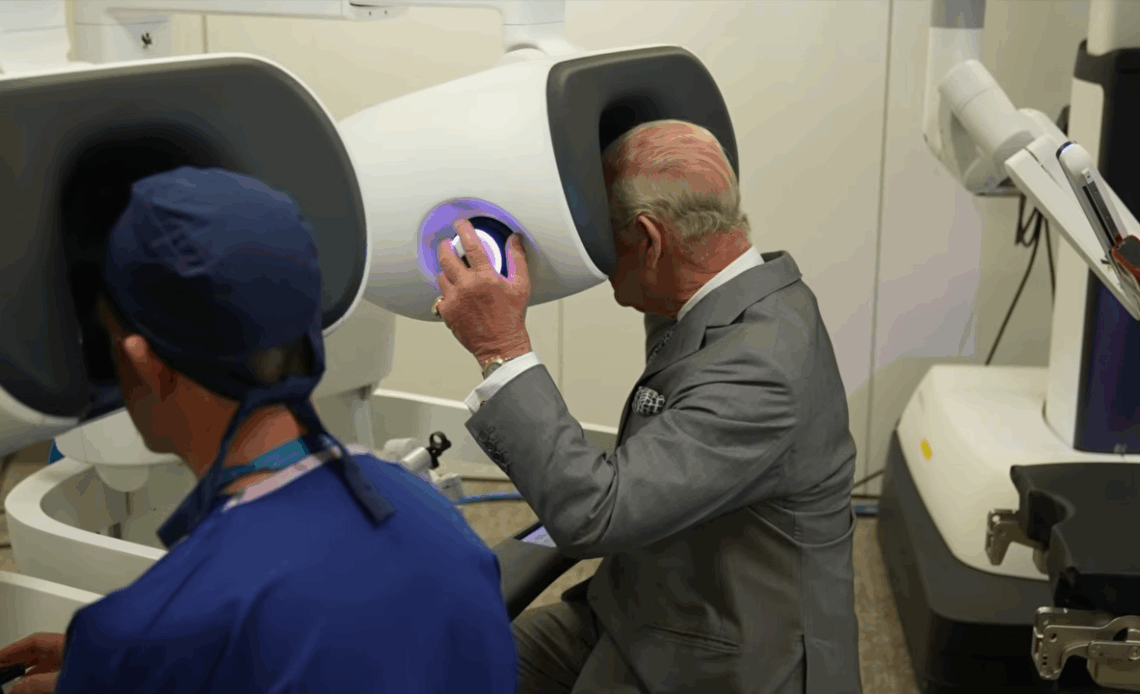
King Charles was guided through the use of a surgical robot to perform bladder cancer surgery, and after attempting it himself quipped, “I think I’ll have to come back after some more training.”
The King paid a visit to Guy’s Cancer Centre on Monday to celebrate 300 years of Guy’s Hospital, and to learn about cancer research projects from Guy’s Hospital and from his patronage, King’s College, London.
During his visit, the King met with medical professionals, patients, and researchers, and learned how the medical teams are using AI and robotics to treat patients.
Professor Ben Challacombe, Consultant Urological Surgeon, walked the King through the new bladder cancer surgical procedure, which, when approved for use in the NHS, will assist surgeons by making more precise and smaller incisions, allowing for more surgeries and quicker recovery times for patients.
King Charles was overheard calling it a “marvellous invention” and was also heard asking about the accuracy of AI, as “it’s not always right.”
The King also paid a visit to the Chemotherapy Village to meet with cancer patients undergoing treatment. He sympathised with Raymond Burgess, who told him about how his chemotherapy leaves a bad taste in his mouth. He replied, “It’s an awful sort of metallic taste. It doesn’t exactly help with eating.”
To another cancer patient, who did not give her name, he commended her bravery in continuing to work while receiving her treatment, telling her “I wish you all the best.”
After his visit, Professor Challacombe told reporters that King Charles had been very interested in the surgical robot and how it could improve outcomes. “So I told him about decreased pain and scars and decreased length of stay, and he actually used the phrase to me, ‘This seems much more minimally invasive than the surgery that I’ve previously heard of’, which was nice.
“I could see he was speaking from the point of view of having been through treatment himself.”
King Charles was diagnosed with an undisclosed form of cancer in February 2024 and began receiving treatments in London. After nearly two years of treatment, he announced last December that “thanks to early diagnosis, effective intervention and adherence to doctors’ orders, my own schedule of cancer treatment can be reduced in the new year.”
The King called it “both a personal blessing and a testimony to the remarkable advances that have been made in cancer care in recent years.”