
For all the success enjoyed by the British Royal Family on the racecourse, the 1909 Derby occupies a unique place in sporting history. When Minoru passed the post at Epsom on 26 May 1909, he did more than win the world’s most famous race. He secured what remains the only Derby victory achieved by a reigning British monarch.
The winner was Minoru, an Irish-bred colt trained by Richard Marsh and ridden by Herbert Jones. Starting among the leading fancies, he produced a determined effort to prevail by a short head from Louviers in a dramatic finish. His winning time was recorded as 2 minutes 42.4 seconds.
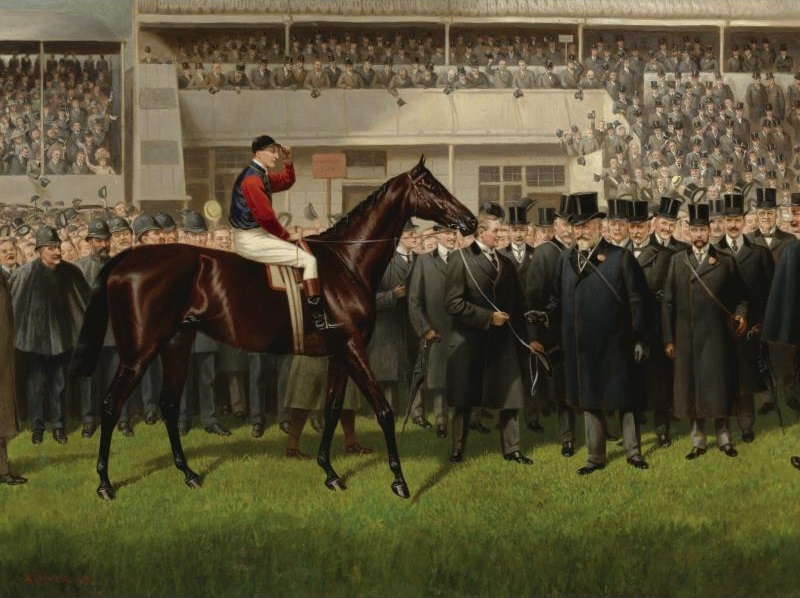
The victory represented the culmination of a long-held ambition for King Edward VII. Before ascending the throne in 1901, he had established himself as one of the most enthusiastic and successful owners in British racing while Prince of Wales. His colours had already been carried to Derby glory by Persimmon in 1896 and Diamond Jubilee in 1900, both celebrated triumphs that enhanced his reputation as a sportsman and breeder.
Yet there remained one achievement missing from his record: winning the Derby as sovereign. The distinction may appear technical, but it mattered enormously in an era when horse racing occupied a central place in British public life. Edward VII’s accession had transformed him from a wealthy racing enthusiast into the embodiment of the Crown. A Derby victory under those circumstances carried symbolic significance far beyond the sport itself.
The scenes that followed Minoru’s success reflected that significance. Contemporary reports describe extraordinary celebrations on Epsom Downs as the crowd cheered the King’s horse home. Edward VII emerged to receive the acclaim of racegoers and personally led Minoru through a jubilant throng. The victory was greeted not merely as a sporting success but as a national occasion.
Minoru’s Derby triumph came only weeks after he had captured the 2,000 Guineas at Newmarket, confirming himself as one of the outstanding colts of his generation. Although he would not secure the Triple Crown, his place in history had already been assured.
What makes the 1909 Derby especially remarkable is that no reigning monarch has repeated the feat. Royal ownership has remained a significant presence in British racing, with subsequent sovereigns enjoying success in many of the sport’s greatest races. The late Queen Elizabeth II, for example, came agonisingly close to Derby glory on several occasions but never managed to win the race. As a result, Edward VII’s achievement stands alone.
More than a century later, Minoru’s narrow victory remains one of the defining moments in the sport of Kings. Edward VII had already conquered the Derby twice as Prince of Wales. In 1909, however, he achieved something far rarer: he won it as King. That distinction ensures the Derby of 1909 retains a unique place in both racing and royal history.