
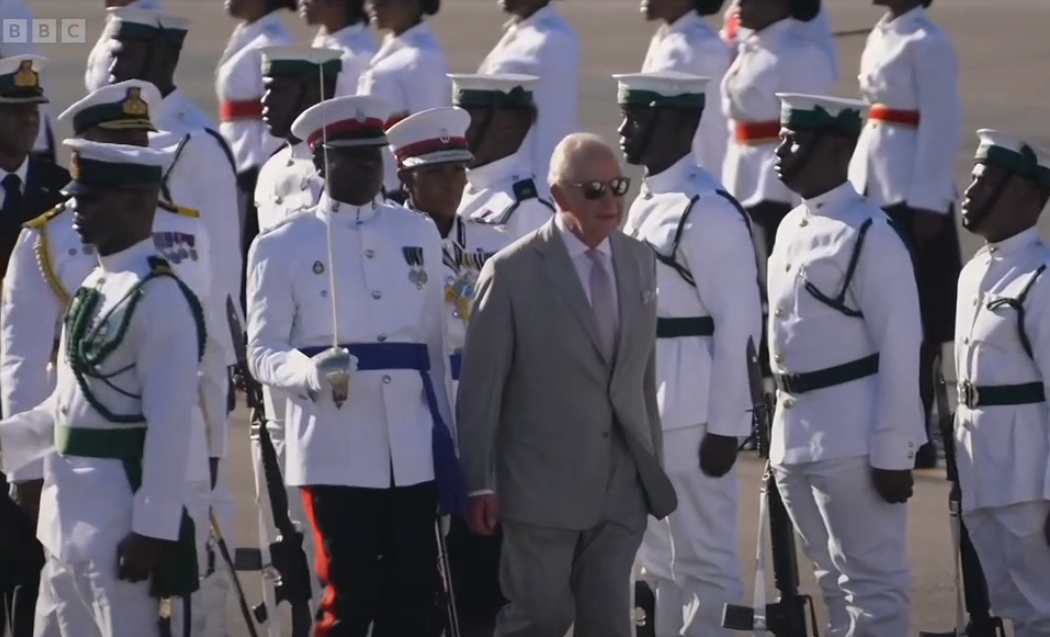
The KING has arrived in the Bahamas to begin a nine-day Caribbean tour, marking his first visit to the region as monarch.
King Charles was welcomed to Nassau on Tuesday, 27 October, as he began a programme of engagements across the Bahamas, Guyana and Antigua and Barbuda.
The visit will culminate in the Commonwealth Heads of Government Meeting (CHOGM), where leaders from across the 56-member organisation will gather to discuss shared challenges and opportunities for cooperation.
His Majesty’s arrival marks the beginning of a significant overseas visit that will celebrate the Caribbean’s culture, recognise its history and highlight opportunities for future generations.
The King welcomed to Nassau
Upon arriving at Lynden Pindling International Airport, The King was formally welcomed by senior Bahamian officials, including Governor General Dame Cynthia Pratt and Prime Minister Philip Davis.
His arrival ceremony included a Guard of Honour formed by members of the Royal Bahamas Police Force and the Royal Bahamas Defence Force.
The King received a Royal Salute before inspecting the Guard of Honour, accompanied by the national anthem of the Bahamas.
The reception marked the official beginning of his visit to the island nation, where he is undertaking a series of engagements celebrating its people, heritage and future ambitions.
A special return to Clifford Park
One of The King’s first engagements took place at Clifford Park in Nassau, where he attended The Future Bahamas Youth Rally and Exhibition.
The location holds historical significance for the King, who visited the Bahamas as Prince of Wales in 1973 to attend celebrations marking the country’s independence and deliver a message from his mother, Queen Elizabeth II, to the Bahamian people.
More than five decades later, he returned to the site as monarch for an event focused on young people and their contributions to the country’s future.
During the rally, The King met young Bahamians involved in science, technology, engineering and mathematics initiatives, entrepreneurship and personal development programmes.
The exhibitions included FEMStem Bahamas, which encourages high school girls to pursue opportunities in STEM subjects, alongside programmes supporting young innovators and students interested in developing solutions to real-world challenges.
He also heard about recipients of the Governor-General’s Youth Awards, which forms part of the Duke of Edinburgh’s International Award programme in the Bahamas.
The rally featured cultural performances celebrating Bahamian traditions, including rake-and-scrape music, alongside contributions from youth and children’s choirs.
The King subsequently addressed those gathered before meeting performers and young people taking part in the event.
A tour reflecting on the past and looking to the future
The Caribbean tour comes at a significant moment for relations between Britain and the region, with renewed calls for slavery reparations and greater recognition of the legacy of colonialism.
As reported by Royal Central, The King acknowledged the suffering of the past during his first engagement in the Bahamas, recognising the historic injustices that shaped the region.
Speaking at a youth rally in Nassau, he reflected on the country’s history, describing its culture as having been born out of darkness and saying it was right to acknowledge historic injustices.
His remarks came as campaigners renewed calls for Britain to apologise for its role in the transatlantic slave trade and provide reparations to affected communities. The UK Government has maintained its position against offering an apology or reparations.
The King is expected to have further opportunities to reflect on the legacy of slavery during the visit, including through engagements at memorials and places of remembrance.
However, the programme will also focus on contemporary partnerships, environmental protection and opportunities for younger generations across the Caribbean.
The Bahamas, like other Caribbean island nations, faces significant challenges from climate change and rising sea levels. The King’s engagements will highlight the importance of protecting the region’s natural environment and biodiversity.
Following his visit to the Bahamas, The King will travel to Guyana, where environmental issues and conservation will feature prominently in his programme.
He will then continue to Antigua and Barbuda, where Queen Camilla will join him for the Commonwealth Heads of Government Meeting.
Commonwealth summit to conclude the visit
The nine-day tour will conclude with the Commonwealth Heads of Government Meeting in Antigua and Barbuda.
The summit will bring together leaders from the Commonwealth’s 56 member countries to discuss shared priorities and strengthen cooperation.
As Head of the Commonwealth, The King is expected to deliver a keynote address during the gathering.