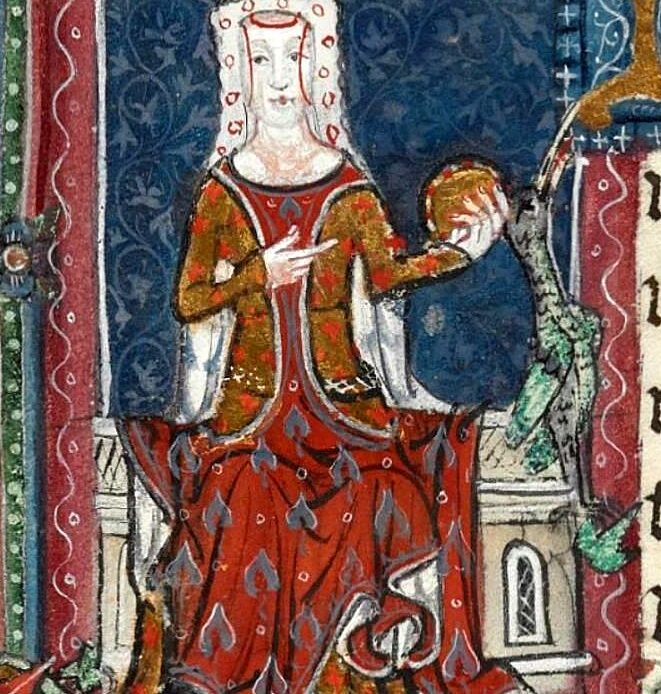
Joan of Kent, also known as the ‘Fair Maid of Kent’, was the first royal bride to hold the title Princess of Wales, and she set a scandalous standard that seems to have echoed down the centuries through its usage.
Joan of Kent was born during a time of tumult and treachery. As a granddaughter of King Edward I through her father, she was of noble birth and grew up in close proximity to her royal cousins, though it wasn’t an idyllic childhood.
The third of four children born to Edmund of Woodstock, 1st Earl of Kent, and Margaret Wake, Joan’s father was executed for treason before her third birthday and she spent her earliest years as a ward of her cousin, King Edward III and Queen Philippa.
Edmund of Woodstock had remained loyal to his half-brother, King Edward II, through the early years of his controversial reign; but when Queen Isabella and Roger Mortimer invaded from France and deposed Edward II in 1326, they did so with his support. But by 1328, he was disenchanted with Isabella and Mortimer, and joined in a plot against them. It failed, but he tried again in 1330, ultimately leading to his execution that year as a traitor against the Crown.
Margaret and her four children—Edmund, 2nd Earl of Kent, Margaret, Joan, and John, later 3rd Earl of Kent—were confined to Arundel Castle until Edward III overthrew his mother and Mortimer and took care of Joan’s family afterwards.
Joan of Kent grew into a beautiful young woman, lauded for her beauty and grace. According to the chronicler Jean Froissart, she was “in her time the most beautiful woman in all the realm of England, and the most loved.”
She would also add a layer of scandal to her reputation every time she married.
Joan’s first marriage, to Thomas Holland, was carried out in secret and occurred around her 12th birthday. Her husband was 26 years old at the time. Though this age gap is scandalous to modern readers, it wasn’t outside the realm of possibility for a woman of Joan’s rank. What made it scandalous is that it occurred without the consent or knowledge of King Edward III, who, as her guardian, should have been responsible for finding her a suitable husband.
Not long after their wedding, Holland was sent to the Continent to continue fighting for the English. As to when, or if, her family learned the truth before her second marriage, it didn’t stop them from marrying her off to William Montagu sometime between 1340 and 1341. Through this childless and loveless marriage, she became Countess of Salisbury in 1344.
Controversy came to Joan’s doorstep in 1348, when Holland returned to England and demanded his wife’s return. Montagu attempted to bar Joan from testifying in court, only releasing her when the Church demanded her testimony. It became such a convoluted affair that King Edward III and Pope Clement VI were involved in its resolution; which came the following year.
In 1349, the Pope declared that Joan of Kent and Thomas Holland’s marriage was still valid and annulled her marriage to William Montagu. She returned to her first husband, and together they had five children, four of whom survived infancy.
Joan of Kent became the Countess of Kent in her own right in 1352, after the death of her second brother. Holland later became Earl of Kent in right of his wife, and the title subsequently passed down through their children. Tragically, Thomas Holland died following an illness in 1360, leaving Joan a widow with four children. But by the next year, she’d be married to Edward, heir of King Edward III, known to history as The Black Prince, and known in his own time as a man of great chivalry and daring. He was a celebrated fighter and popular throughout the realm.
Of course, their marriage was not without controversy, because they, too, married in secret and without the King’s consent. Once it became public knowledge that the couple had married—and Joan was not considered an optimum bride for a future king due to her two marriages and the scandal swirling around her—the King worked with his son to ensure that all the necessary dispensations were met so that they could legally, and publicly, marry.
Their first, secret marriage was annulled.
On 10 October 1361, Edward and Joan of Kent were married by the Archbishop of Canterbury at Windsor Castle. As wife of the heir to the English throne, Joan assumed the title Princess of Wales.
Joan and Edward were a true love match and stayed together throughout their marriage. Within a year of their second, official marriage, the couple were named Prince and Princess of Aquitaine and Gascony due to the King granting the Crown’s French holdings as territorial designations to his heir. They soon moved to Aquitaine and set up a court there.
Their marriage produced two sons: Edward of Angoulême and Richard of Bordeaux. Sadly, Edward died by his fifth birthday, and so Richard was groomed to be king following his grandfather and father.
The Black Prince’s health began to fail after a decade of constant battle and campaigning, and so the royal couple and their son returned to England. In 1376, Edward died at Westminster Palace at the age of 45.
Joan would never be Queen of England, but she would be mother to a king. A year after his father’s death, King Richard II, a ten-year-old boy, was crowned at Westminster Abbey.
Joan would remain actively involved in raising her son, who reigned through a regency council during his minority years. She is said to have worked extensively to maintain good relations with Edward’s brothers, ensuring that she would not be displaced from her influential role. Despite the issues facing King Richard II, Joan’s reputation was unscathed.
One of her last public acts was to arrange her son’s marriage to Anne of Bohemia; with a queen consort in place, Joan is said to have retired to one of her castles.
In the final year of her life, Joan saw her family divided as her sons Richard II and John, 1st Duke of Exeter (through her marriage to Thomas Holland) became embroiled in conflict. John was said to have quarrelled with Sir Ralph Stafford, resulting in his death, and was condemned to die.
Joan, overwhelmed, fell ill and dictated her will on 7 August 1385. She died the next day. And for all her grief, she may have been relieved by the outcome of her sons’ fight: Richard pardoned his brother and sent him on crusade to get him out of the kingdom.
The first Princess of Wales lived a life swirling in scandal, though as a royal bride and consort, she carried herself with grace and led with a commanding presence. Formidable as the mother of a king, she had the courage, wits, and determination that would have lent well to being a queen consort in a time of battle and upheaval.
Joan of Kent is buried next to her first husband, Thomas Holland, at Greyfriars in Stamford, Lincolnshire.