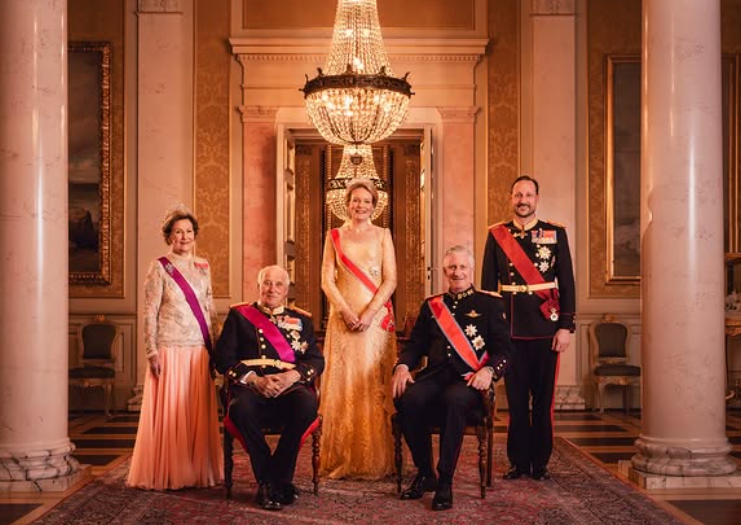
Queen Mathilde of the Belgians has worn one of the most important jewels in her royal family’s collection and there’s an added significance to her choice this time round.
For decades, a striking all diamond diadem has been in use by Belgian queens but in 2026, wearing it has an extra symbolism.
For Queen Mathilde chose to wear the ”Nine Provinces” tiara exactly 100 years after it came to Belgium.
The tiara has a strikingly modern design for a royal jewel, showing its relatively recent acquisition. It was created in 1926 for Princess Astrid of Sweden when she married the then heir to the Belgian throne, Leopold.
This was the first major tiara creation of the 1920s and the first big diadem to be shaped for a queen since the fall of many royal houses at the end of World War One. The gem was being designed for a new version of royalty and it shows. It has a very different look and carries all the echoes of the Art Deco phase that had had such a big influence in all spheres of design.
The diamonds in this tiara are studded into two separate pieces that come together to make a towering piece. There is a discreet bandeau forming the base of the diadem which features a meander design, a popular idea for royal tiaras in the early 20th century. The original version also had a series of diamond ‘toppers’, huge stones that sat on top of the base on spikes.
(Kongehuset)
The tiara was given to Astrid to mark her wedding and came on behalf of the people of Belgium although it was created and paid for by the Belgian jeweller, Van Bever. The original design suited the ultra fashionable Astrid who was known for her modern style. However, as she settled into her role as Duchess of Brabant, she decided to switch it up.
Princess Astrid had diamond arches made to sit on top of the toppers, adding an even more unusual and modern shape to the tiara. She often wore it with the base across her forehead, giving it an even more striking appearance. In 1934, her husband became King of the Belgians and her tiara became that of a queen. It’s remained that ever since.
Queen Astrid of the Belgians died in 1935, just over a year after her husband took the throne. She was killed in a car accident and her death was widely mourned. The tiara became one for ‘queens only’ and when Astrid’s son, King Baudouin, married in 1960, it was worn by his bride, Fabiola.
Since then, it’s been used by Queen Paola and, from 2013, by Queen Mathilde who became eligible to use it on the accession of her husband, King Philippe, that year.
Its latest appearance came at the State Banquet given in honour of Philippe and Mathilde by the King and Queen of Norway, Harald V and Sonja, as they welcomed their Belgian counterparts to Oslo for a State Visit.
There was also a personal, family nod in its choice. Astrid was a maternal aunt of King Harald although the two never met. He was born in 1937, to years after her death. However, Astrid had already left her mark on the Norwegian royal family. Her sister, Martha, and her husband, Olav, had named their second daughter after her. Princess Astrid of Norway was born in 1932 and the aunt she shared her name with was among her godparents.
Queen Mathilde’s choice of tiara ticked plenty of boxes and also gave a glimpse of this sparkling jewel, a century after its creation.