All brides need a bouquet and a royal bride is no different. Flowers are as much a part of a wedding as the dress, the cake and the first kiss but they are usually filled with special meanings that add a personal as well as regal element to the whole day. And the flowers carried by the Princess of Wales for her marriage to Prince William in April 2011 had a very special nod to her groom among them.
Catherine’s bouquet was small, neat and made of locally grown flowers, all of them white. It was laced with green leaves and wired into a shield shape that kept its form throughout the day.
The dominant flower in the bouquet is lily of the valley. This highly scented plant usually blooms as May gets underway, and it’s been a wedding favourite for years (in fact, this bouquet has been compared many times with the one carried by Princess Grace of Monaco which was also largely composed of lily of the valley).
The bride gave a nod to her groom in her bouquet, adding in Sweet William, that favourite flower found in many gardens. The posy also included ivy and hyacinth as well as a very traditional royal bloom indeed. For nestling among all those flowers was a sprig of myrtle taken from a bush planted at Osborne House by Queen Victoria. Royal brides have included this in their bouquets since the 19th century in a tradition that has stood the test of time.
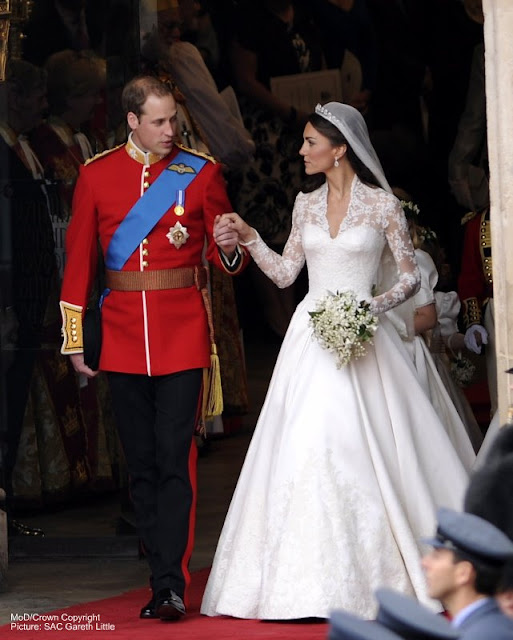
(MOD Crown Copyright)
Much was made at the time of the language of flowers in this wedding bouquet. As you would expect from a wedding bouquet, love features heavily. The ivy symbolizes wedded love and the hyacinths mean constancy of love. The myrtle, that royal wedding bouquet staple, is the emblem of marriage. Sweet William denotes gallantry while lily of the valley stands for ‘a return to happiness’.
The flowers had one final part to play in this royal wedding. Once the celebrations were over, the bouquet was returned to Westminster Abbey where it was placed on the Tomb of the Unknown Soldier. It’s a tradition that was started almost a century ago when the Queen Mother, then Lady Elizabeth Bowes-Lyon, put her own wedding flowers on the tomb on the way into her royal wedding on April 26th 1923. She had lost a brother, Fergus, in World War One and laid her bouquet there to remember him and all those who died in that conflict. All senior royal brides since have followed suit.
Truth be told, this bouquet divided opinion – some thought it was the perfect foil to her famous lace-covered dress while critics thought it too small and hard to make out in the majesty of Westminster Abbey.
And as well as a nod to Prince William, some saw a hint of another royal in Kate’s flowers. The bouquet carried by the Princess of Wales was immediately compared to the one used by Princess Grace of Monaco at her royal wedding in 1956.
Like Kate, the flowers carried by Grace Kelly were small and discreet. And Grace’s bouquet featured lily of the valley – in fact, it was the main flower in her posy. Grace had tea roses for her chief bridesmaid, Peggy, while her other attendants all carried daisies. However, the bride at this royal wedding only carried lily of the valley.
Lily of the valley is often used by royal brides for its lovely meaning as well as its sweet scent and delicate petals. Like Grace, Kate used it as well to accent the lace in her wedding dress.
And the wedding bouquet of Kate Middleton, now Princess of Wales, became as famous a part of her wedding look as the gown, the veil and the tiara as well as being a very symbolic start to married life.
Kate’s bouquet is the focus of one of over two dozen royal wedding floral features in our new anthonology. You can buy Royal Weddings: A Collection from Royal Central on Amazon in both ebook and paperback.