
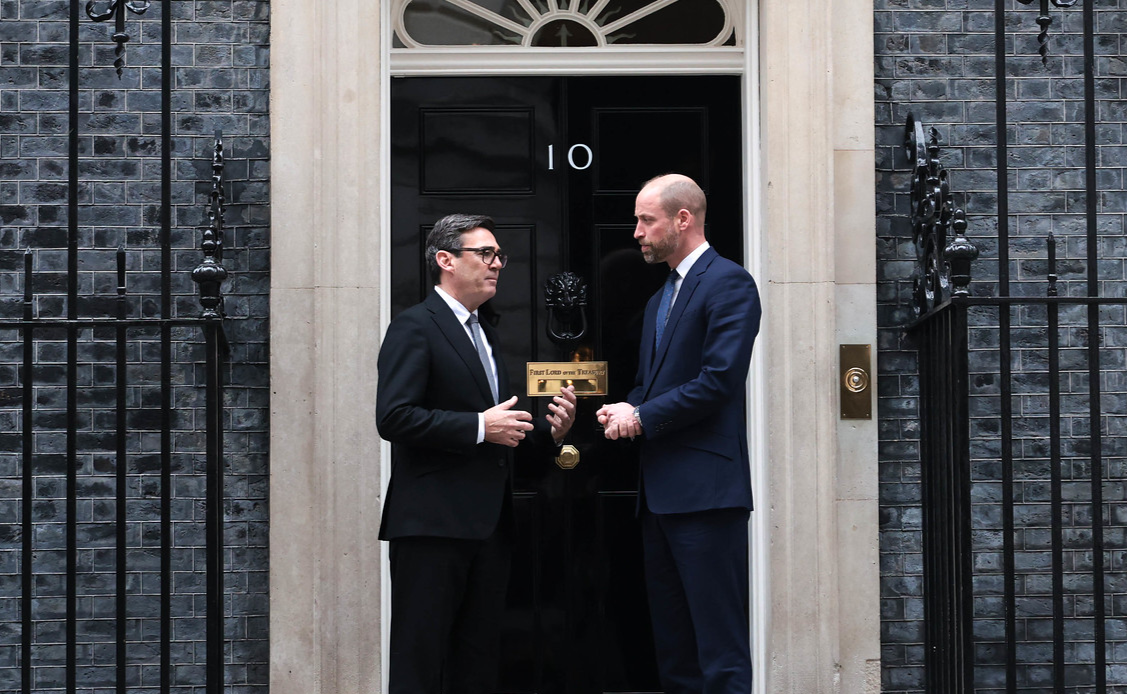
King Charles has not made a formal visit to 10 Downing Street in almost four decades, despite having spent much of his life working alongside the country’s political leaders.
The last time the King was formally at the Prime Minister’s famous London residence was in November 1989, when he attended a dinner hosted by Margaret Thatcher alongside his then-wife, Princess Diana.
More than 37 years later, Charles has yet to return, with his eldest son, Prince William, making his own historic visit to the famous black door on Tuesday, November 24.
The Prince of Wales was welcomed by Prime Minister Andy Burnham before the pair held a meeting lasting around 50 minutes to discuss shared priorities, including homelessness and the environment.
William’s visit was the first by a senior working royal since Queen Elizabeth II attended a Cabinet meeting at Downing Street in 2012.
But while the Prince’s appearance attracted considerable attention, it also raised an interesting question: why has his father not visited the famous address since 1989?
The explanation is rooted in the constitutional relationship between the monarch and the Government.
Unlike an elected politician, the King is expected to remain politically impartial and does not routinely visit the Prime Minister at their official residence.
Instead, it is the Prime Minister who traditionally travels to meet the sovereign.
King Charles holds a private weekly audience with the Prime Minister, usually at Buckingham Palace, where the two discuss matters relating to the Government and the affairs of the country.
These meetings are an important part of the monarch’s constitutional responsibilities and are kept entirely confidential.
The King is entitled to be consulted, to encourage and to warn his ministers, although he must remain politically neutral.
The arrangement means Charles does not need to make regular appearances at Downing Street to maintain a close working relationship with the person leading the Government.
Indeed, the weekly audiences have been a longstanding feature of the British monarchy, with Queen Elizabeth II maintaining the tradition throughout her 70-year reign.
Charles has continued the practice since becoming King in September 2022.
His last formal visit to Downing Street came when he was still Prince of Wales.
In November 1989, he and Diana attended a dinner hosted by Margaret Thatcher, who was then Prime Minister.
It was not the first time Charles had visited the building. In 1971, the then Prince of Wales attended meetings at Downing Street to learn about the workings of the British Government.
He was photographed alongside the then Prime Minister Edward Heath during the visit.
Charles also visited the residence on other occasions during his time as heir to the throne, but the 1989 dinner is understood to have been his last formal appearance there.
The late Queen, meanwhile, had a much-publicised visit in December 2012, when David Cameron welcomed her to attend a Cabinet meeting during her Diamond Jubilee year.
She had also visited Downing Street in 1985 to mark its 250th anniversary and famously dined there with Winston Churchill in 1955, shortly before his resignation as Prime Minister.
The monarch’s relationship with the Prime Minister is one of the most important parts of the UK’s constitutional arrangements, despite much of the work taking place behind closed doors.
William will eventually inherit the same responsibilities when he becomes King.
For now, he is expected to meet the sitting Prime Minister at least once a year, although those meetings do not necessarily take place at Downing Street.
He met Sir Keir Starmer at Kensington Palace in 2025, before Tuesday’s visit to No 10.
The Prince’s appearance was described as another step in his development as a future head of state, with further diplomatic engagements expected on behalf of the Government next year.
While William has now walked through the famous black door, his father’s absence from the address for more than 37 years is not the result of a constitutional dispute or a personal snub.
Rather, it reflects the unusual nature of the British monarchy, where the head of state and the head of government maintain one of the country’s most important relationships largely in private.