
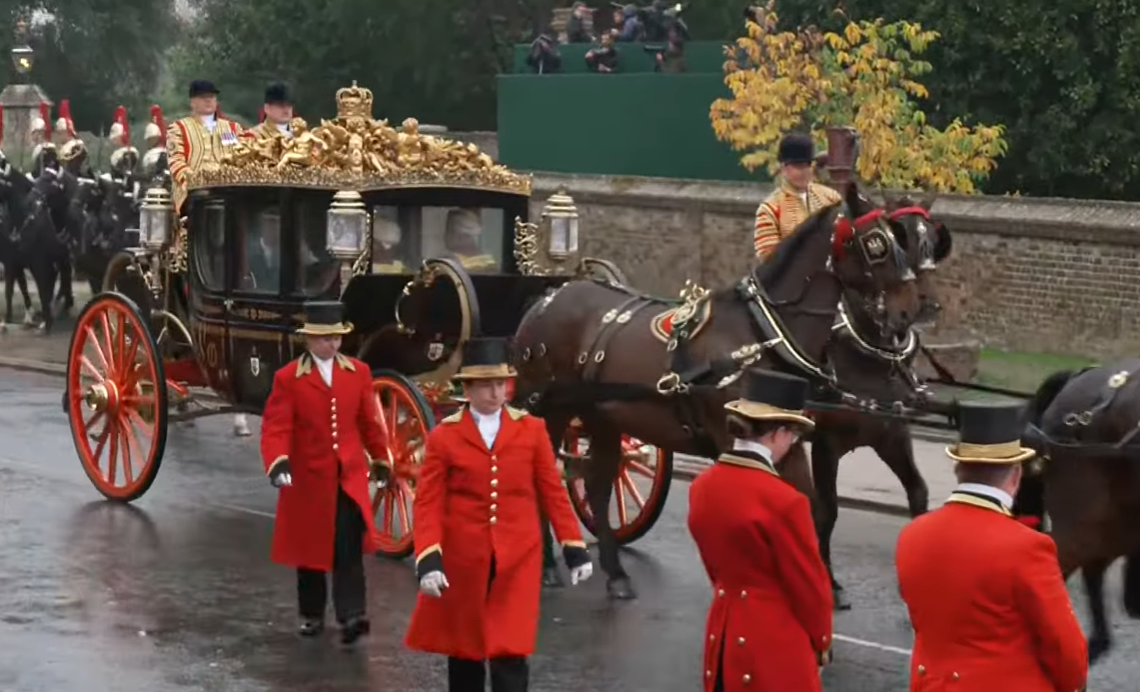
The Prince and Princess of Wales travelled in one of the Royal Family’s most distinctive carriages during the Sultan of Oman’s State Visit, but the Australian State Coach is far more modern than its traditional appearance might suggest.
William and Kate shared the enclosed carriage with two senior members of the Omani delegation as the royal procession made its way through Windsor on Tuesday, October 20.
Sayyid Theyazin bin Haitham Al Said, Oman’s Deputy Prime Minister for Economic Affairs, and Sayyid Loay bin Ghalib Al Said, Secretary General of the Diwan of the Royal Court, accompanied the royal couple.
The Australian State Coach formed part of a five-carriage procession welcoming Sultan Haitham bin Tarik to Britain for a visit celebrating the longstanding relationship between the two countries.
But the carriage carrying William and Kate has a particularly interesting history, having been presented to the late Queen Elizabeth II by the Australian people.
A gift from Australia to the late Queen
The Australian State Coach was presented to Queen Elizabeth II in 1988 to mark Australia’s bicentenary, commemorating 200 years since the establishment of the first British settlement at Sydney Cove in 1788.
The gift represented the close constitutional and historical connections between Australia and the British Royal Family.
Although it retains the traditional appearance of a horse-drawn carriage, the Australian State Coach incorporates several modern features that distinguish it from the monarchy’s older vehicles.
Its enclosed design offers protection from the elements, while modern engineering makes journeys considerably more comfortable than they would have been in some of the Royal Family’s historic open carriages.
Among its features are electric windows, heating and hydraulic suspension, combining traditional craftsmanship with contemporary technology.
How does it compare with the Gold State Coach?
The Australian State Coach is considerably more modern than the famous Gold State Coach, one of the most recognisable vehicles in the Royal Collection.
Commissioned for King George III and completed in 1762, the Gold State Coach is an elaborate, gilded carriage used for major royal occasions, including coronations.
Its ornate decoration and historic construction make it a symbol of traditional royal pageantry, although its age means journeys can be uncomfortable for those travelling inside.
The Australian State Coach, by contrast, was designed with modern comfort in mind while retaining the appearance expected of a ceremonial royal carriage.
It is also distinct from the Irish State Coach, which carried King Charles and Sultan Haitham during Tuesday’s procession, and the Scottish State Coach, used by Queen Camilla.
A prominent role in the State Visit
The Australian State Coach occupied an important position in the procession through Windsor, following the leading carriage carrying the King and Sultan.
The royal party travelled from Datchet Road through the town before entering Windsor Castle’s Quadrangle, where the visiting ruler received a formal military welcome.
William and Catherine subsequently joined the King and Queen for the ceremonial proceedings, which included an inspection of the Guard of Honour and military displays.
The State Visit highlights the diplomatic relationship between Britain and Oman, with defence, trade and regional security among the important areas of cooperation.