
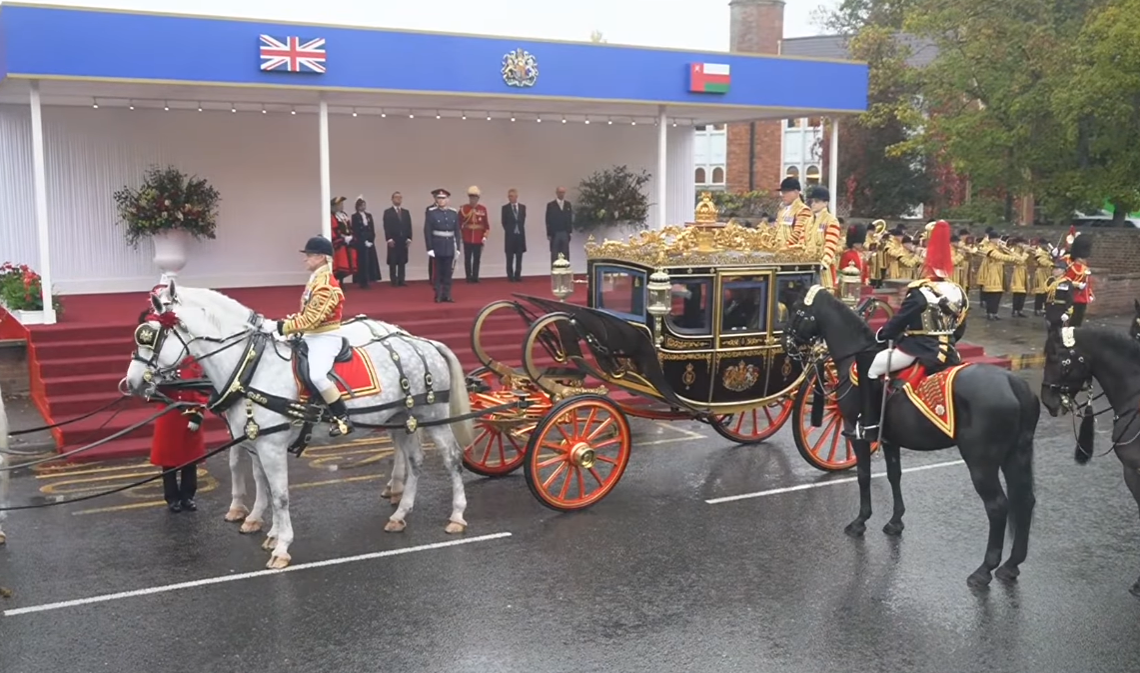
The Prince and Princess of Wales joined King Charles and Queen Camilla in a spectacular carriage procession through Windsor as the Royal Family welcomed the Sultan of Oman for a historic State Visit.
William and Kate travelled in the Australian State Coach alongside two senior members of the Omani government, Sayyid Theyazin bin Haitham Al Said, Deputy Prime Minister for Economic Affairs, and Sayyid Loay bin Ghalib Al Said, Secretary General of the Diwan of the Royal Court.
The Prince and Princess of Wales followed the King and Sultan Haitham bin Tarik, who shared the Irish State Coach at the head of the procession.
Queen Camilla travelled in the Scottish State Coach alongside Sayyid Shihab bin Tariq Al Said, Oman’s Deputy Prime Minister for Defence Affairs.
The procession brought together senior members of the British Royal Family and prominent representatives of the Omani government for a ceremonial welcome highlighting the longstanding relationship between the two countries.
Who travelled in each carriage?
The procession featured several of the Royal Family’s historic state carriages, with guests allocated places according to their royal and official positions.
The Irish State Coach
The first carriage carried King Charles and Sultan Haitham, placing the two heads of state at the forefront of the procession.
The Scottish State Coach
Queen Camilla travelled alongside Sayyid Shihab bin Tariq Al Said, Deputy Prime Minister for Defence Affairs.
The Australian State Coach
The Prince and Princess of Wales shared the carriage with Sayyid Theyazin bin Haitham Al Said, Deputy Prime Minister for Economic Affairs, and Sayyid Loay bin Ghalib Al Said, Secretary General of the Diwan of the Royal Court.
The first Ascot Landau
The next carriage carried four senior Omani officials: Sayyid Khalid Hilal Al Busaidy, Minister of the Diwan of the Royal Court; General Sultan Mohammed Al Nomani, Minister of the Royal Office; Sayyid Hamood Faisal Al Busaidi, Minister of Interior; and Sayyid Badr Hamad Al Busaidi, Foreign Minister.
The second Ascot Landau
The final carriage carried Dr Hamed Said Al Oufi, Head of the Private Office; Dr Madiha Ahmed Al Shaibani, Minister of Education; Hussein Ali Abdullatif, Adviser at the Private Office; and Anwar Hilal Al Jabri, Minister of Commerce, Industry and Investment Promotion.
Grand military welcome at Windsor Castle
The carriage procession travelled from Datchet Road through Thames Street, the High Street and Park Street before passing through Cambridge Gate and the George IV Gateway into Windsor Castle’s Quadrangle.
Members of the British Armed Forces lined the route, providing a ceremonial welcome for the visiting delegation.
As the carriages entered the Quadrangle, a Guard of Honour formed by Nijmegen Company Grenadier Guards and F Company Scots Guards delivered a Royal Salute. The Band of the Scots Guards performed the Omani and British national anthems.
The King, Queen and Sultan then left their carriages and took their places on a ceremonial dais.
William and Catherine stood alongside the two Omani Deputy Prime Ministers, with the Prince of Wales continuing his prominent role in the day’s proceedings.
The Sultan, accompanied by the King, subsequently inspected the Guard of Honour before rejoining Charles and Camilla.
The ceremony continued with a series of military displays, including a march past by The King’s Troop Royal Horse Artillery, a rank past by the Sovereign’s Escort and a further march past by the Guard of Honour.
A significant diplomatic occasion
The ceremonial proceedings formed part of the opening day of Sultan Haitham’s State Visit to the United Kingdom, which is intended to reinforce the longstanding ties between Britain and Oman.
The Gulf state occupies a strategically important position near the Strait of Hormuz, a vital international shipping route, and has developed a reputation for maintaining diplomatic channels with Western governments and regional powers.
Defence cooperation, trade and regional security are among the important areas underpinning the relationship between the two countries.
Following the formal welcome, the Royal Family was due to host the Sultan and his delegation for a private lunch at Windsor Castle, followed by a viewing of historic Omani objects from the Royal Collection.
The day’s programme will conclude with a State Banquet hosted by the King and Queen in honour of the visiting ruler.