
The question is no longer purely theoretical: could the United States attempt to take control of Greenland? President Donald Trump has repeatedly raised the possibility, citing the island’s strategic location in the Arctic and its wealth of minerals essential for high-tech industries. Recent public statements, including a provocative tweet from the wife of a Trump aide showing Greenland in American colors alongside the word “SOON,” have thrust this “what-if” scenario into real-world urgency, prompting alarm in Copenhagen and Nuuk alike.
Denmark Draws a Clear Red Line
Denmark’s Prime Minister, Mette Frederiksen, has addressed the U.S. “very directly,” saying there is no justification for any threats toward Greenland. “The United States has no right to annex any of the three nations in the Danish kingdom,” she said. Greenland, she emphasized, is covered under NATO’s security guarantees, and Denmark already maintains a defense agreement giving the U.S. access while retaining Danish control.
“The people of Greenland have very clearly said they are not for sale,” Frederiksen added, underscoring that any American attempt to seize the island would violate both international law and centuries of Danish sovereignty.
King Frederik: A Royal Symbol of Resistance
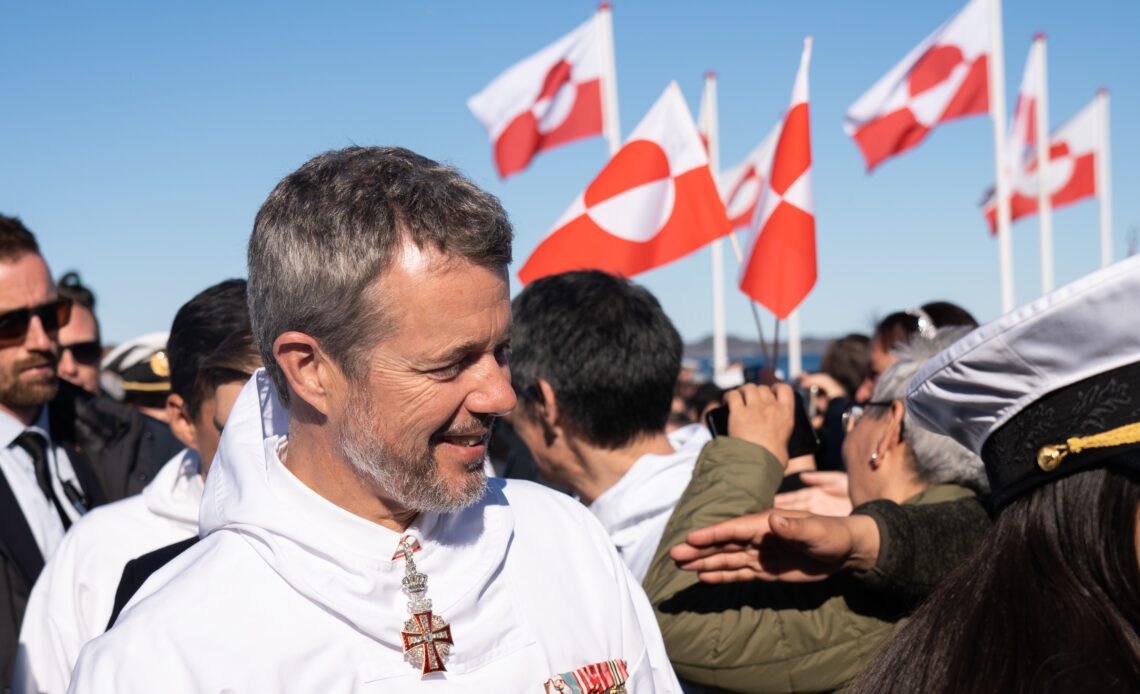
While King Frederik does not wield direct political or military power, in such a crisis the monarch would become the symbolic face of Denmark’s resolve. Imagine him addressing the nation from Amalienborg Palace, calm but firm, reassuring both Greenlanders and Danes that the crown stands united behind them. A royal visit to Greenland itself – however logistically complex – would send an unmistakable message: the monarchy is personally invested in the island’s safety and sovereignty.
King Frederik paid special visits to the country in 2025 and shared his support for Greenland amidst the ongoing geopolitical events. In a sharp statement on Danish television in March, the King said “We live in an altered reality.”
Monarchs wield a unique form of soft power. Even without commanding troops, King Frederik’s words and presence could shape global perception, rally domestic support, and pressure allies to defend Denmark’s position. In short, his role would be diplomatic, moral, and symbolic—but no less critical.
Greenland: Strategic, Sovereign, and Determined
Home to just 57,000 people, Greenland has extensive self-government but relies on Denmark for foreign policy and defense. While some Greenlanders favor eventual independence, opinion polls show overwhelming opposition to becoming part of the United States. Any U.S. move to annex the island would clash not only with Danish sovereignty but also with Greenlandic self-determination.
The island’s value goes beyond geopolitics: it sits at the gateway to the Arctic, possesses rare earth minerals crucial to modern technology, and offers strategic positioning for military and scientific operations. This makes Greenland a potential prize, but also a flashpoint for an international crisis.
A Royal Reminder of Denmark’s Sovereignty
If the United States were to test these boundaries, King Frederik would serve as the embodiment of Denmark’s sovereignty and the protector of Greenland’s people. The monarchy would act as both a symbol of continuity and a diplomatic lever, ensuring that any aggression is met with global scrutiny and unambiguous opposition.
In today’s world, where tweets can spark international tension, the question of Greenland’s future is urgent – and King Frederik would be at the center of this unfolding story, standing for his kingdom, the Arctic, and centuries of royal guardianship.