The Duchess of Edinburgh was the last royal bride of the 20th century and her bridal look has a place in the history books.
When Sophie Rhys-Jones walked into St. George’s Chapel, Windsor to marry Prince Edward, the eyes of the world were on her. This wedding would bring to an end a century of regal weddings for the House of Windsor and Queen Elizabeth II made sure the tiara worn by the bride matched the occasion. But despite hints about just how special this piece is, Buckingham Palace has never answered questions about the real origins of the piece.
On its first appearance, all the Palace would say is that the all diamond elements of the tiara had been taken from Queen Elizabeth’s personal collection. The tiara had never been seen before and it was an unusual piece, featuring a band of gems, topped with four striking shapes made of diamonds.

Despite the lack of information about the tiara’s origins, ideas soon began to form. The first was that the diamond shapes that topped the tiara had actually come from a set that was part of a coronet belonging to Queen Victoria. In fact, it seemed that the quarter of gems had once been used to shape Queen Victoria’s Regal Coronet. That jewel no longer exists but it seems parts of it have lived on.
It was an historic pick by Queen Elizabeth II and linked Sophie to the royal brides who had come before her. St. George’s Chapel, Windsor had been a popular place for regal weddings during the later 19th century and Victoria was responsible for that. It had begun sadly when she decided that the wedding of her eldest son, Edward, had to be held there as she was in deep mourning for her husband, Prince Albert. But then it slowly took hold as a royal wedding place and, in 1999, Sophie became part of that story.
The tiara has since acquired a name. It’s sometimes known as the Anthemion Tiara as the diamond parts that top it are shaped in anthemion motifs. That part of the royal jewellery pick was seen as a nod to Prince Philip – it is a Greek design and the father in law to whom Sophie was devoted was born in Corfu as a Prince of Greece and Denmark.
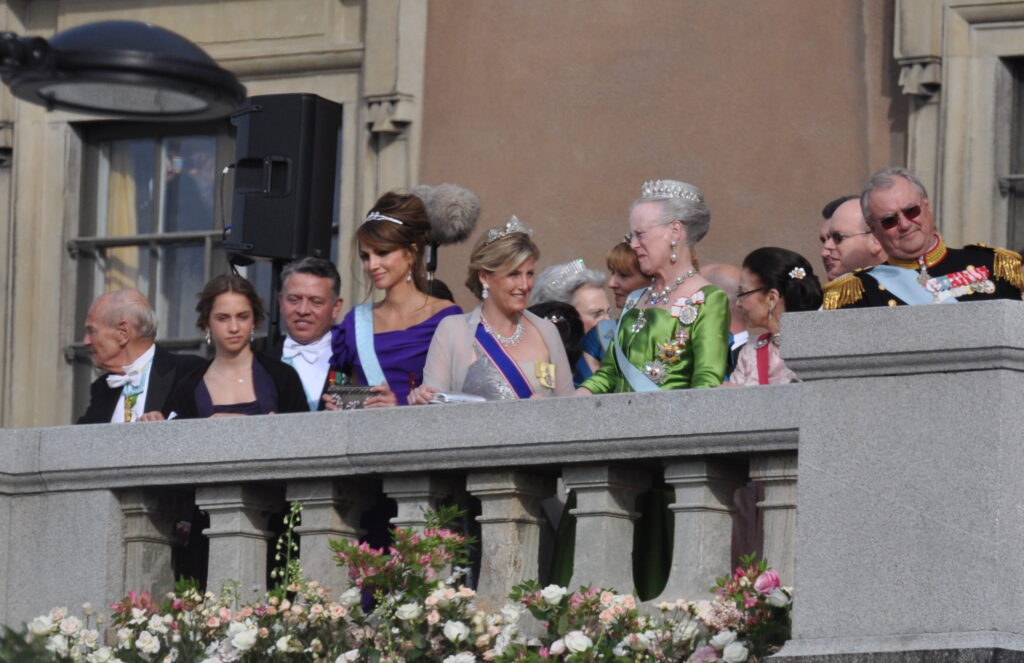
(By Holger Motzkau 2010, Wikipedia/Wikimedia Commons (cc-by-sa-3.0), CC BY-SA 3.0)
The wedding dress it accompanied was a classic design. She wore a full length coat dress over an ivory tulle dress. It featured long sleeves with fluted cuffs.
One of the most striking features of Sophie’s bridal look was the amount and manner of embellishment on the dress. While both Lady Diana Spencer and Sarah Ferguson had opted to have motifs on their wedding gowns, Sophie used her sparkle more subtly. There were over 325,000 pearls and crystal beads on the coat dress, train and veil, added in discreet patterns to give an overall lustre to the wedding outfit. They are perhaps most noticeable on the front of the coat dress, where they sit in neat lines along the bodice and opening of the skirt.
The other gems chosen by Sophie were among the most romantic worn at a royal wedding. The bride chose a necklace designed for her by her groom. Prince Edward took inspiration from the medieval architecture of St. George’s Chapel and created a set featuring a combination of black gems and pearls.
Since her wedding, Sophie has worn the tiara many times, including to several royal weddings abroad. In 2019, she had the piece slightly remodelled and the anthemions are now worn closer together.
Despite the speculation about the tiara, Buckingham Palace has never said any more about its origins. It is a royal wedding mystery that continues to fascinate.