

The death of Princess Bajrakitiyabha after more than three years in a coma has removed one of the most prominent figures in Thailand’s royal family and intensified long-standing uncertainty over who will eventually succeed King Vajiralongkorn.
The 47-year-old princess, widely regarded as one of the most capable and experienced members of the House of Chakri, died on Thursday after never recovering from a medical emergency that left her unconscious in December 2022.
Although questions about the future of the Thai monarchy have lingered since her collapse, her death now leaves the succession issue more unresolved than at any point in recent years.
Princess Bajrakitiyabha, known to many Thais as Princess Pa, had long been viewed by royal observers as the most credible future leader of the monarchy. Highly educated, internationally respected and trusted by her father, she appeared to possess many of the qualities expected of a future sovereign or regent.
A lawyer by training, she earned advanced degrees from Cornell University in the United States before serving as a prosecutor, diplomat and ambassador. She later became a prominent advocate for prison reform and women’s rights within the justice system, while also taking on senior military and royal responsibilities.
Her position within the royal family made her an obvious focus of succession speculation, particularly after constitutional changes introduced in the 1970s allowed women to inherit the throne.
However, despite widespread assumptions about potential heirs, King Vajiralongkorn has never publicly designated a successor.
Attention has often centred on the King’s youngest son, Prince Dipangkorn Rasmijoti, who is generally regarded as the most likely heir. Yet the 20-year-old prince has spent much of his life outside Thailand and has largely remained out of public view. Reports over the years have questioned whether he would be able to assume the demanding role of monarch, although no official clarification has ever been provided.
The uncertainty surrounding Prince Dipangkorn helped elevate Princess Bajrakitiyabha’s standing in the eyes of many royal watchers. Before her collapse, she was frequently seen undertaking official duties and was entrusted with increasingly senior positions by her father, including a role within his personal military bodyguard unit.
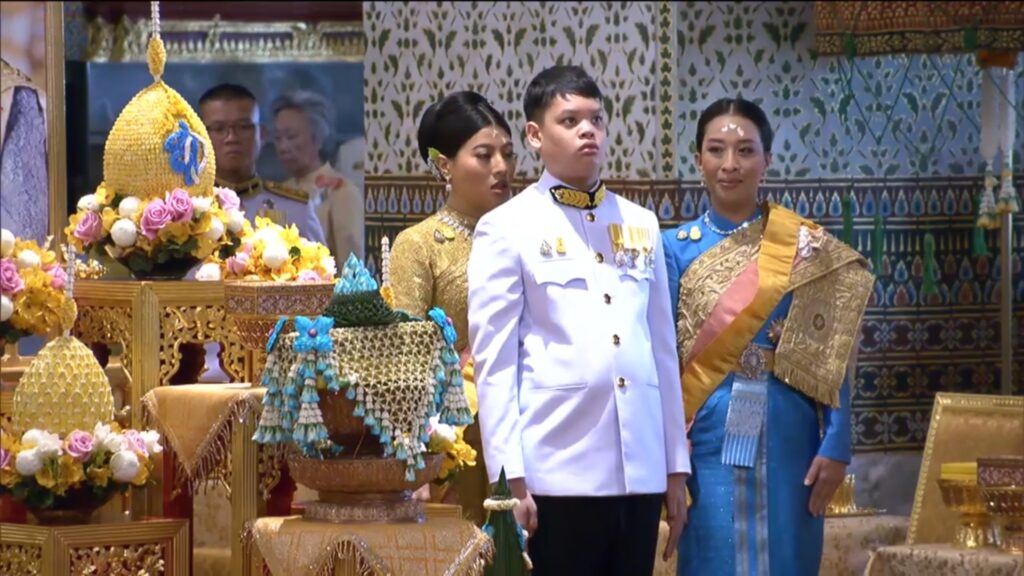
Her younger half-sister, Princess Sirivannavari, is also technically eligible to succeed under Thailand’s succession laws. However, she has generally attracted less speculation than Princess Bajrakitiyabha and has built a public profile focused largely on fashion, sport and cultural projects.
The succession picture became even more intriguing in 2023 when Vacharaesorn Vivacharawongse, one of the King’s four exiled sons, made a surprise return to Thailand after nearly three decades in the United States.
His highly publicised visit prompted widespread speculation that he might be returning to the royal fold following Princess Bajrakitiyabha’s hospitalisation. The four brothers were stripped of their royal status and sent into exile following the collapse of their parents’ marriage in the 1990s.
While some observers viewed Vacharaesorn’s return as a possible sign of reconciliation, questions remain over whether he would be eligible to inherit the throne. Reports have suggested that his marriage to a foreign national could complicate any claim under Thailand’s succession laws.
For now, the question of who will one day inherit the throne remains unanswered.
Public discussion of royal succession in Thailand is exceptionally sensitive because of the country’s strict lese-majeste laws, which prohibit criticism of the monarchy and can carry severe penalties. As a result, debate that would be commonplace in many constitutional monarchies is often conducted only cautiously and indirectly.
Princess Bajrakitiyabha’s death therefore represents more than the loss of a senior royal figure. It removes a widely respected candidate who many believed could have provided stability and continuity for the institution.
With King Vajiralongkorn now 73 and no publicly declared heir, the future direction of the Thai monarchy remains one of the kingdom’s most closely guarded unanswered questions.