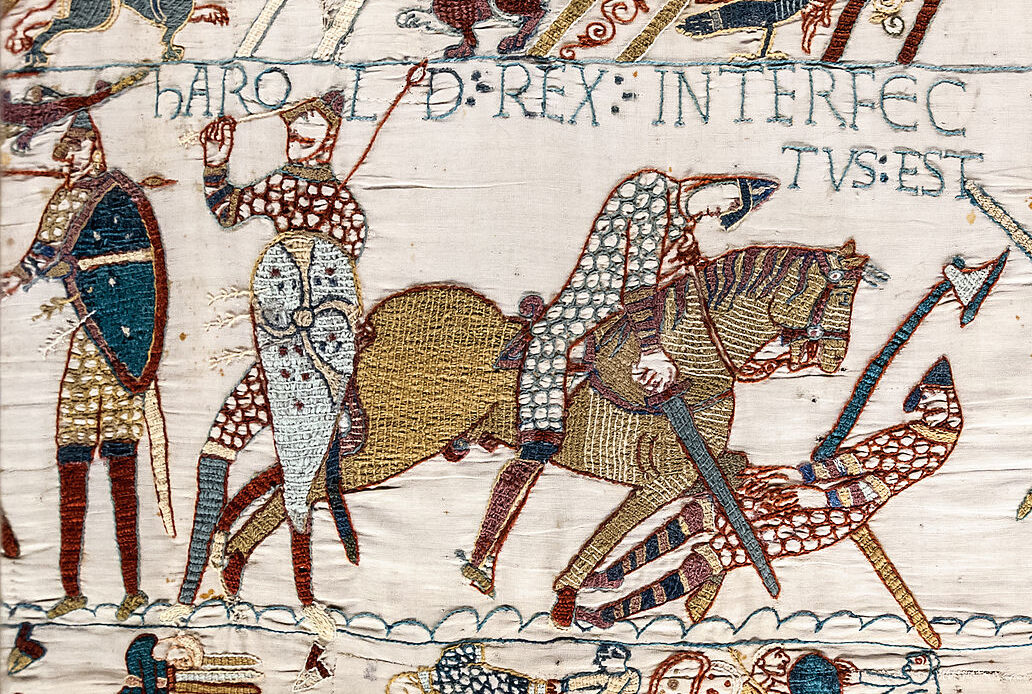
It’s one of the most famous pieces of royal history in the world and it could be about to head under the sea.
It’s reported that the Bayeux Tapestry, which tells the story of how William the Conqueror ended up as King of England, is to be brought to London via the Channel Tunnel.
Royal history causing concern
Concerns over transporting the ancient artwork have been growing since it was confirmed it will be coming to England for the first time in over nine centuries.
The tapestry is being lent to the British Museum for a blockbuster exhibition which is set to open in September and which is expected to attract hundreds of thousands of visitors during its autumn stay in the capital. Some estimates put the total number coming to see it at over one million and tickets aren’t even on sale yet.
The Sunday Times has reported that the plans for moving the tapestry to England now expect the train to take the strain. The paper said that the artwork will be put on its own train through the Channel Tunnel to reach England, taking it around 75 metres under the surface of the sea.
However, the details of how the tapestry will be moved from France to England are being kept top secret, such is the security around the priceless piece of embroidery.
Since French President, Nicholas Sarkozy, confirmed that the tapestry would go on loan to the UK, there have been claims that moving such a delicate piece of work could damage it. Concerns have been raised about the impact of rutted roads and potholes on the tapestry as well as the ventilation and temperatures in which the cloth will be stored as it is moved to London from its permanent home in Bayeux.
A royal PR push
It’s believed that the tapestry was created in England in the late 11th century and one of the aims of its designers was to show the victory of William the Conqueror at Hastings as rightful.
William, Duke of Normandy arrived in England in the early days of October 1066 to claim the throne he said had been willed to him by Edward the Confessor, who had died childless. However, following his death, in January 1066, Harold Godwineson had taken the throne and was reigning as King Harald II. William and Harald met at Hastings on October 14 1066 for what would be one of the most famous battles in history. William won but then had to impose his rule on England and prove himself its rightful king in the eyes of those who didn’t believe in his claim. The tapestry was part of that PR push.
Measuring almost 70 metres in length, the tapestry is packed with representations of politics and battle but one of its most famous panels is sure to attract plenty of attention. It shows Harald being hit in the eye with an arrow, one of the most famous moments in English history.
The British Museum is making big plans for the tapestry, with doors set to open in September for the once in a lifetime exhibition. It is planning to show the whole artwork in one, long line rather than the U shaped display used in Bayeux. And visitors will first walk into a mezzanine floor which will give an overview of the sheer size of the tapestry before they descend to get up close with it.
Protecting the tapestry on this, its longest journey in centuries, has been paramount. It was taken off display in Bayeux several months ago and is undergoing restoration and inspection before its move to the UK. Once in London, it must be kept in strict conditions and there are limits on how long it can be exposed to light every day it is on show.
In exchange for the chance to show the Bayeux Tapestry, the British Museum is lending out several famous artefacts including items from Sutton Hoo as well as some of the 7th century Lewis chess pieces.