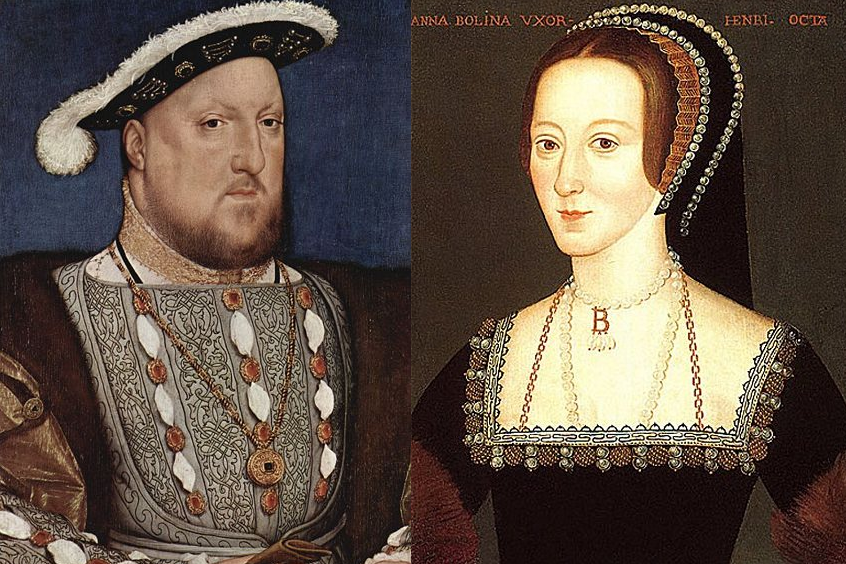
The famous portrait of Anne Boleyn that has become the modern image of the tragic queen is probably not a painting of her at all.
Instead, one leading expert thinks that the face in the portrait is actually that of her daughter, Queen Elizabeth I.
The picture in question is kept in the National Gallery in London. It depicts Anne Boleyn, who was Queen of England between 1533 and 1536, as dark haired and dark eyed and it’s become a compelling piece of evidence in modern interpretations of her story
Now, top Tudor historian Owen Emmerson, says that close study of the image shows a more than striking resemblance to a portrait of Queen Elizabeth I in the Compton Verney collection.
And this likeness goes far beyond a similarity between mother and daughter. Dr. Emmerson, who is curating a brand new exhibition on Anne Boleyn at her childhood home of Hever Castle, says the painting is part of a series where the faces of monarchs were duplicated on to likenesses of other famous figures.
Dr Emmerson says the portrait could well be part of a plan to show that Elizabeth I was the rightful Queen of England. For Elizabeth had been declared illegitimate by her father, Henry VIII, when he ended his marriage to Anne Boleyn and her enemies often seized on that fact.
His theory is that the portrait, which was made several decades after Anne Boleyn’s execution, was part of a series in which past royals were painted but with the features of Elizabeth added to them to show that she was the true royal line.
He told The Daily Telegraph that ”it’s one artist doing a series of portraits of monarchs and putting on the face of the reigning queen, Elizabeth, to show a legitimate and God-ordained line of succession.”
The National Gallery said it was always interested in discussions around the paintings in its collection.
If this is shown to be true, it brings into question again the true appearance of Anne Boleyn. Nearly every likeness of her made in her lifetime was destroyed after her fall to keep Henry VIII happy. She was arrested at the beginning of May 1536 on suspicion of treason and found guilty just days later at a trial by peers. She was executed on May 19 1536 at the Tower of London and buried in the Chapel of St. Peter ad Vincula there.
The famous portrait has been the base of many 20th and 21st century interpretations of Anne who, for over a century, has been depicted as dark haired and having brown eyes. However, Dr. Emmerson believes she might actually have been a red head. Her daughter, Elizabeth, was famously flame haired and Henry VIII also had auburn locks. Owen Emmerson says the MCIR gene ”is the primary determinant for red hair”.
That would tie in with another portrait said to be of Anne, created by Hans Holbein. That shows her with red hair caught under a bonnet.
Anne Boleyn remains one of the most talked about and enigmatic people in royal history. She first came to the attention of Henry VIII around 1525 and by 1527 he had asked the Pope to annul his marriage to Catherine of Aragon so that he could marry Anne. When the Pope refused, Henry began a battle that would last years and lead to his split from Rome and the creation of the Church of England. It would be a turning point in British and European history.
Now, it appears that our idea of the woman at the centre of it all might well be wrong.
The exhibition, Capturing A Queen: The Image of Anne Boleyn opens at Hever Castle on February 11 2026 and runs until January 1 2027.