
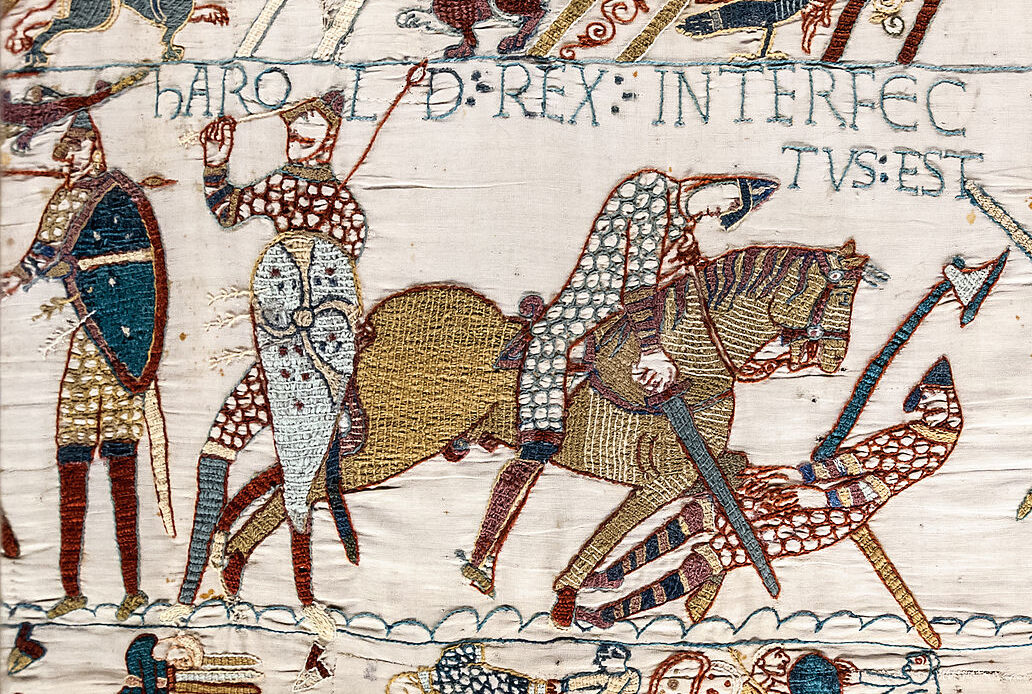
The Bayeux Tapestry has arrived in England for the first time in almost 1,000 years, marking one of the most significant cultural loans ever agreed between Britain and France. The extraordinary 11th-century embroidery, which tells the story of the Norman Conquest of England in 1066, was transported across the Channel under tight security before arriving at the British Museum in London, where it will go on public display from September.
The 70-metre-long embroidered masterpiece has remained in Normandy for centuries and has become one of France’s greatest national treasures. Historians believe it was created in England during the 1070s, probably by Anglo-Saxon embroiderers, before being taken to Bayeux shortly after the Norman Conquest. Its return to the country where it is thought to have been made is therefore being described as a remarkable homecoming.
The operation to move the fragile textile was planned over many months by conservation experts from both countries. Because of its immense historical importance and delicate condition, the tapestry travelled inside a specially designed climate-controlled, shock-absorbing container that protected it from vibration, changes in humidity and temperature throughout its journey. Engineers even carried out trial runs using replica textiles to ensure every stage of the transport could be completed safely.
The transfer was conducted largely in secret, with the tapestry crossing the Channel overnight before being taken directly to the British Museum. Security surrounding the journey was exceptionally tight, reflecting the priceless nature of the embroidery and the logistical challenge of moving an artefact that has rarely left its permanent home in Bayeux.
The tapestry’s arrival fulfils an agreement announced during French President Emmanuel Macron’s state visit to Britain in 2025. The loan was presented as a powerful symbol of the close relationship between the United Kingdom and France, with both governments describing it as an act of cultural friendship. In return, Britain will lend a number of nationally important artefacts, including treasures from Sutton Hoo, to museums in France.
Although commonly known as the Bayeux Tapestry, the work is technically an embroidery rather than a tapestry. Stitched in coloured wool onto linen, it contains 58 scenes featuring more than 600 people, hundreds of animals and dozens of ships. Its vivid images chronicle the dramatic events leading to William the Conqueror’s invasion of England, culminating in the Battle of Hastings, one of the defining moments in British history.
Experts say the loan represents a once-in-a-generation opportunity for visitors to experience one of the world’s greatest surviving medieval artworks. Before going on display, conservators will carry out extensive condition assessments and allow the embroidery to acclimatise after its journey. It will then be displayed inside a specially constructed showcase designed to minimise exposure to light while maintaining constant environmental conditions throughout the exhibition.
Public demand has already proved extraordinary. The exhibition has attracted huge interest, with tickets selling rapidly months before the official opening. Museum officials expect millions of visitors during the tapestry’s stay in London, making it one of the biggest cultural events ever staged by the British Museum.
The tapestry is expected to remain in Britain until the summer of 2027 while its permanent museum in Bayeux undergoes extensive renovation work. Once conservation and redevelopment projects in Normandy are complete, it will return to France to resume its place as one of Europe’s most treasured historic artefacts.
For historians, the tapestry’s arrival is far more than the temporary relocation of an ancient artwork. It represents the return of a remarkable piece of shared Anglo-French history to the country where it was almost certainly created nearly a millennium ago. Whether viewed as a masterpiece of medieval craftsmanship, a political document or an illustrated account of one of Britain’s defining battles, the Bayeux Tapestry remains one of the most extraordinary survivals from the medieval world. Its historic arrival in England is therefore not only a museum event but a cultural milestone, offering a rare chance for modern audiences to stand before one of history’s greatest visual narratives.