
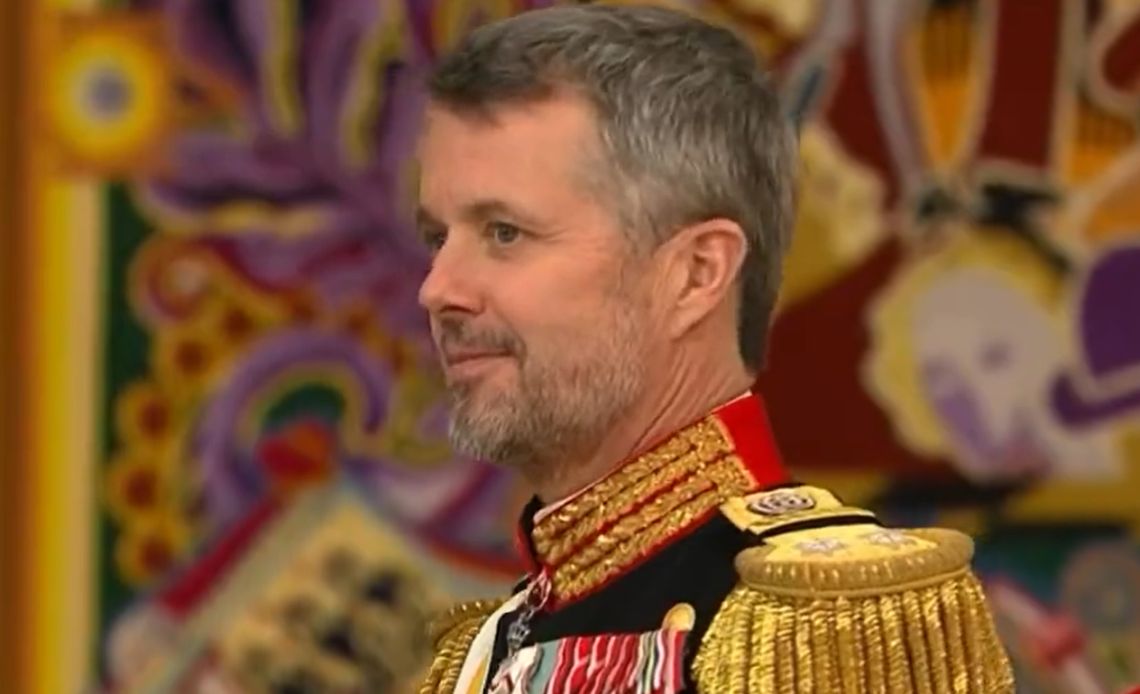
He’s the second newest ruler on the continent of Europe but King Frederik X’s honeymoon period is well and truly over. As he marked the second anniversary of his accession to one of the oldest thrones in the world, he found the realm he inherited under threat.
Frederik X reigns over the Kingdom of Denmark and its very future is now a matter of global debate. That debate has also seen the formal and rather historic name of his realm given a new currency: as Prime Minister, Sir Keir Starmer, spoke out about the situation, he referred to the Kingdom of Denmark.
The Kingdom of Denmark, belonging to Frederik X, is a trio of places. Frederik is sovereign of Denmark, where he lives and where most of his constitutional duties take place.
However, the kingdom also contains two autonomous regions: the Faroe Islands and Greenland. All three make up the realm of Denmark over which Frederik X reigns. He has shown a deep devotion to the island, even giving two of his four children Greenlandic middle names. One of his first actions on taking the throne was to increase the prominence given to Greenland’s symbol on royal crests. But that’s now all against a backdrop of growing US demands for the island with Donald Trump now imposing tariffs on countries that oppose his plans.
It was as he was reacting to the plans, which would see 10% added to all goods imported to the US from countries including the UK, that Sir Keir Starmer added an historical flourish, saying ”our position on Greenland is very clear – it is part of the Kingdom of Denmark and its future is a matter for the Greenlanders and the Danes.”
Culture secretary, Lisa Nandy, who took on the usual Sunday morning round of TV interviews for the government just hours later, told the BBC’s Laura Kuenssberg Show that ”the future of Greenland is a matter for the people of Greenland and the people of the Kingdom of Denmark.”
The Kingdom of Denmark and Greenland’s role in it has a long history. Greenland was first claimed by Europeans in the late 10th century by Erik the Red who ended up there after being banished from the Norse settlements on Iceland. When he was allowed back home he did such a good sales job on his temporary home that dozens of ships followed him back to settle there. His son, Leif Eriksson, used Greenland as a base from which to settle parts of North America.
The Norse community in Iceland had its own form of government until the 13th century and Greenland followed a similar pattern. But in 1262 that fell apart and both countries submitted to the rule of the Kingdom of Norway meaning that the first European royal to technically hold power in Greenland was Haakon IV Haakonsson. For over a century, Norway’s kings were rulers of Greenland, too.
In the late 14th century, the Kalmar Union joined Denmark, Sweden and Norway as well as their overseas territories under the personal rule of one monarch, Margaret I, who named her great nephew, Eric of Pomerania, as he successor. However, by the time Christian II saw the union dissolved in 1523, Greenland’s Norse population had all but disappeared.
The Thule people, from whom modern Greenlanders descend, were already establishing power across parts of the island by then. But another European monarch also fancied claiming the island for himself. King Manuel I of Portugal sent an expedition in the first years of the 16th century as he tried to establish his supremacy in his fight against Spain for world domination. His sailors were trying to find a route into Asia via the icy waters of northern Europe. Instead, they charted parts of Greenland which briefly appeared on maps made for Manuel as ‘Lavrador’, a name later given to parts of Canada.
After that, European interest in Greenland waned until the early 17th century when King Christian IV of Denmark ordered his navy to explore and conquer. They had little luck but around 100 years later, during the reign of Frederick IV, a Danish expedition arrived in Greenland and set up trading bases there. The new arrivals worked alongside the Inuit people who had lived there unchallenged for centuries.
In 1814, King Frederick VI of Denmark hung on to Greenland in the Treaty of Kiel but the Norwegians never forgot their claim. In 1931, during the reign of King Haakon VII of Norway, the country declared the eastern part of the island to be ‘Erik the Red’s Land’ and the matter ended up at the Permanent Court of International Justice in 1933. There, the Norwegian claim was thrown out.
However, soon afterwards global war meant another change in Greenland. The Nazi occupation of Denmark, bravely countered by King Christian X, led to the US taking over the island to prevent it falling into Hitler’s hands. At the end of World War Two, it returned to Danish rule and during the reign of King Frederik IX it was made part of Denmark with citizenship of the nation given to all Greenlanders.
The rule of Queen Margrethe II saw more changes. In 1979, Greenland was granted home rule while in 2009, self rule was initiated although Denmark still controls foreign policy and defence. But while it has a European head of state, the island itself has a very different identity. Almost 90% of the 57, 000 people living there are of Inuit descent and the official language is now Greenlandic.
Meanwhile, it’s worth remembering that Donald Trump isn’t the first US President to ask if Greenland is for sale. In 1946, the administration of Harry S. Truman asked if it could buy the island but Frederik X’s great grandfather, Christian X, and his government declined the offer.